
LANGYI / MATERIALS IN APPLICATION
HyMax® FUNCTIONAL ADDITIVES
Chain Extenders
vs. Hydrolysis Stabilizers
What’s the difference?
A chain extender helps raise a polymer’s processing viscosity. Yet the finished product may still lose strength and become brittle in hot, humid conditions.
Why does this happen? If both chain extenders and hydrolysis stabilizers can improve material performance, what makes the choice between them important?
The two have something in common: both can react with polymer chains or end groups, and both may influence viscosity and mechanical properties. The main difference lies in how they work. Chain extenders focus on linking polymer chains; hydrolysis stabilizers focus on slowing hydrolytic degradation.
One helps modify chain structure and processing behavior. The other helps materials withstand the continuing effects of moisture. Understanding this distinction makes it easier to match the additive to the problem.
01 /
Hydrolysis stabilization: why do materials become brittle over time?
Polyesters such as PET, PBT, PLA and PBAT contain ester bonds in their molecular chains. Moisture can hydrolyze these bonds, particularly at elevated temperatures, causing chain scission.
As chains become shorter, molecular weight decreases, affecting strength, toughness and processing behavior. Carboxyl end groups formed during hydrolysis can also accelerate further hydrolysis, allowing degradation to continue.
For products exposed to humidity, hot water or hot, humid environments, initial performance is only the starting point. Slowing subsequent property loss is equally important.
Langyi’s HyMax® hydrolysis stabilizers use carbodiimides as the active component. By reacting with carboxylic acids, they reduce the contribution of reactive carboxyl groups to further hydrolysis, helping slow chain degradation and retain material properties.

HyMax® hydrolysis stabilizers
The HyMax® hydrolysis stabilizer range includes monomeric, polymeric and masterbatch options for different resins and processing needs. Applications include hydrolysis stabilization of PET, PBT, TPU, PLA and PBAT.
From polyester films to elastomer products, the central question is the same: can the material retain its properties for longer when exposed to moisture and heat?
02 /
Chain extension: creating new connections between polymer chains
When the challenge is insufficient processing viscosity, reduced molecular weight or the resulting molding and performance issues, the polymer’s chain structure becomes an important starting point.
Chain extenders form new connections between polymer chains through chemical reactions. This increases chain length and molecular weight, helping adjust processing behavior and overall material performance.
Langyi’s HyMax® KL series consists of reactive chain extenders containing epoxy groups. These groups can react with functional groups such as carboxyl and hydroxyl groups in polymers to extend their chains.
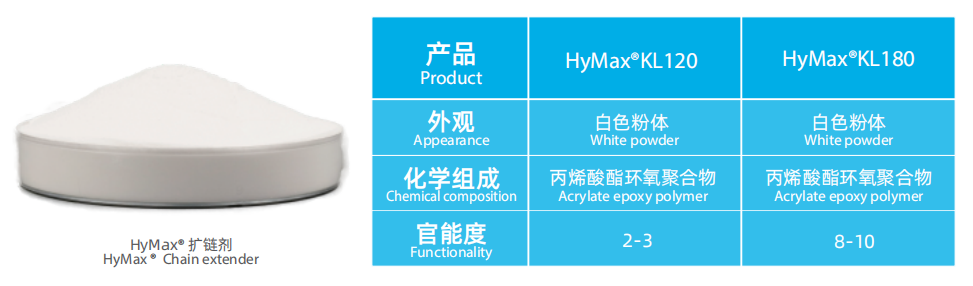
HyMax® KL series · product characteristics
This reaction offers a route to improving or recovering overall polymer performance. For applications involving viscosity adjustment, processing performance or property recovery, chain extension is a modification strategy worth considering.
Its value goes beyond changing a viscosity number: adjusting chain structure can help a material meet the requirements of subsequent processing and the finished product.
03 /
Where do they overlap—and where do they differ?
Chain extenders and hydrolysis stabilizers are often discussed together because both interact with reactive groups in polymers and influence material behavior.
Their reaction pathways differ. HyMax® KL uses epoxy groups to link polymer chains, focusing on chain growth and property adjustment. HyMax® hydrolysis stabilizers use the reaction between carbodiimides and carboxylic acids to reduce factors that promote hydrolysis.
This explains the opening example. An improvement in viscosity after processing indicates a change in the material. Retaining strength and toughness during exposure to hot, humid conditions also requires effective control of hydrolytic degradation.
There can be functional overlap. Some polymeric hydrolysis stabilizers can also affect viscosity while improving hydrolysis resistance. Assessing both processing behavior and properties after aging gives a more complete picture of formulation performance.
04 /
From application needs to formulation design
↗ Films, packaging and plastics processing: start with the processing challenge.
For PET, PLA, PBAT and similar materials, HyMax® KL chain extenders can be considered when the priority is processing viscosity and forming behavior. Resin end groups, processing temperature and the forming process all help determine suitable reaction conditions.

PLA / PBAT · application examples
↗ Humid and hot, humid service environments: design for property retention.
For polyester films, industrial plastic components and polyester-based TPU products exposed to sustained moisture or elevated temperatures, consider a HyMax® hydrolysis stabilization approach. Compare tensile strength, elongation at break and other relevant properties before and after aging to align additive selection with service requirements.

Polyester and polyurethane · application examples
↗ Processing and durability together: evaluate a combined approach.
When both processing viscosity and durability in hot, humid conditions matter, chain structure modification and hydrolysis protection can be considered together. A chain extender can help improve processing behavior, while a hydrolysis stabilizer helps slow subsequent hydrolysis.
Begin with three questions: Which resin is being used? What needs to improve during processing? What environment will the finished product encounter?
Then match the additive type, product form and incorporation method, and refine the formulation through processing trials and aging tests. This connects formulation design with production and service needs.
05 /
Two approaches, each with a clear purpose
Choosing between chain extension and hydrolysis stabilization comes down to matching the reaction pathway to the material’s needs.
Langyi’s HyMax® KL chain extenders link polymer chains to help improve processing behavior and improve or recover overall properties. HyMax® hydrolysis stabilizers react with carboxylic acids to help delay hydrolytic degradation and improve property retention in hot, humid conditions.
For polyester modification, films, packaging, plastics and elastomer applications, Langyi can support the selection of chain extenders, hydrolysis stabilizers and combinations based on the resin system, processing conditions and service requirements.
Talk to Langyi about your material challenges and explore a HyMax® functional additive solution for your application.